|
Creative
Nonfiction Interviews C.M. Mayo
by Phil Maciak
 C.M. Mayo's
essay, "The Essential Francisco Sosa or, Picadou's Mexico
City" appears in issue no. 23 "Mexican Voices"
edited by Ilan Stavans. C.M. Mayo's
essay, "The Essential Francisco Sosa or, Picadou's Mexico
City" appears in issue no. 23 "Mexican Voices"
edited by Ilan Stavans.
Read
the complete essay
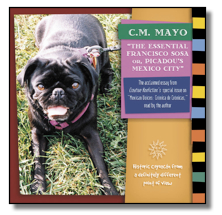
Find out about the
audio CD
For more about Creative Nonfiction please visit www.creativenonfiction.org
What
pleases you about the way your essay turned out? Are there ways
in which it fell short of your original goals?
It was fun
to write. Having fun is seriously under-rated, you know.
 How did your
essay develop, both in your initial thinking about it and in
the revision process? What happened in the writing that you didn't
expect would happen? How did your
essay develop, both in your initial thinking about it and in
the revision process? What happened in the writing that you didn't
expect would happen?
I had been
reading James Howard Kunstler's Geography of Nowhere,
a brilliant rant ‘n rave about "the tragic sprawlscape
of cartoon architecture, junked cities, and ravaged countryside"
that so much of the U.S. has become. (And Mexico, I would add.)
And I was thinking about how I live in an older Mexico City neighborhood
where houses and shops are packed tightly together, and people
tend to walk a lot. So, I thought, what is, actually, a typical
walk for me now? And why do I prefer this to living in a automobile-oriented
suburb? So I went for a walk — my typical walk, one I've
made more times than I could even estimate— but for the
first time, really, deeply paying attention. I took a notebook
with me, and when I came home I made more notes. The biggest
surprise was the trees, how many there are, and how different
from one another they are along Francisco Sosa, their different
leaves and blossoms, the shadows they cast, the silhouettes they
make, and how the light shines through them onto the walls and
the sidewalk.
How
does your experience writing creative nonfiction depend upon
or depart from your work in other genres?
It depends,
rather than departs from my fiction and poetry above all because
I rely so much on imagery and dialogue. To write nonfiction—
at least the nonfiction I've written to date— I need to
first get out into the world, look, take notes, interview people,
check facts, and so on, whereas with fiction and poetry, I can
stay completely within my own dreaming. But I don't have to.
Speculate
about creative nonfiction as an emerging genre in American literature.
Where do you see it going?
While the term
"creative nonfiction" may be new, this type of writing
is not. To give one of scads of examples: Frances Calderón
de la Barca's Life
in Mexico, published in 1843. If that is not a superb
example of creative nonfiction, I don't know what is.
But certainly, there is more "creative nonfiction"
being published today, and Creative
Nonfiction and other literary journals are bringing out
highly innovative and interesting work. This is wonderful. As
for where I see "creative nonfiction" going, I think
it will go in as many directions as there are people who want
it write it and people who want to publish it.
The megaphenomenon of our time is that the cost of publishing
has plummeted. And now that there is print-on-demand and above
all, the web, publishing is wide open to almost anyone with access
to a computer. Whether a given piece of writing can attract readers
is another question.
What
advice do you offer new writers?
Listen to your
own heart. That said, for craft, I found Philip Gerard's Creative
Nonfiction helpful, and for a sense of perspective, Carolyn
See's Making a Literary Life and Betsy Lerner's The
Forest for the Trees. (More recommendations here.)
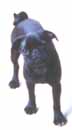 Why was Picadou
such an effective or appropriate guide to Mexico City? How does
Picadou change the narrative? What does her presence add? What
does that say about the city? Why was Picadou
such an effective or appropriate guide to Mexico City? How does
Picadou change the narrative? What does her presence add? What
does that say about the city?
If Picadou
is as you put it, "an effective or appropriate guide,"
I think it is to the degree that her point of view is unexpected.
And she's such a fun little dog! She's such a darling, and I'm
telling you, I cannot walk her without at least one person —
and oftentimes several— coming up to pat her, admire her,
give her treats, scratch her, even try to pick her up. On two
occasions a stranger has actually knelt down on the sidewalk
to kiss her on the head. Children have mobbed her. One man stopped
his car, rolled down the window, and shouted at me, "THAT
IS THE CUTEST DOG I HAVE EVER SEEN!"
OK, I am a pug nut, and I may be biased about my own pug, but
you should know that there were more "admiration events"
while walking down Francisco Sosa that were edited out of this
essay.
Well, reluctantly moving on... Second, Picadou is (though I sometimes
forget) a dog, and dogs live "in the now"— they
are not trotting down the street ruminating about who said what
ten minutes ago, or what might happen in six months from now
if the real estate market takes a dip. So, to "see"
my daily walk with fresh and full attention, it seemed to me
that my dog could help provide that experience.
Third, as I pointed out in the essay, she's not the only pampered
pooch in Mexico City— and the world of the people who are
(ahem) owned by the pampered pooches, is, to me, highly interesting
and, indeed, a very vibrant part of the city.
Speak
a little about why Picadou, and, thus, the whole narrative perspective
of the piece, is often concerned with or situated in the context
of other dogs (past and present) of Mexico City?
One of my points
is that the Avenida Francisco Sosa, unlike much of the "modern
sprawlscape," has an evident past. This can be heartbreaking,
but it can also make the present richer and more beautiful. And
so it is for me in remembering past dogs, as well.
For
much of your piece, the narration is that of an observer, a sharp,
yet subjective, recorder of details— a Nick Carraway to
Mexico City's Gatsby. However, toward the end, it becomes clear
that you are inescapably bound to all that has been described.
If Mexico City is, as you say it, "hurtling toward disaster,"
what role do you and Picadou play alongside the Bohemians, the
tourists and the other inhabitants of Francisco Sosa?
We are here
now, part of Mexico City. We may not be here later. Certainly,
we will not be here forever. This is true, of course, of everyone
and everything everywhere. |

 C. M. MAYO