|
 Rose Mary Salum
Interviews Rose Mary Salum
Interviews
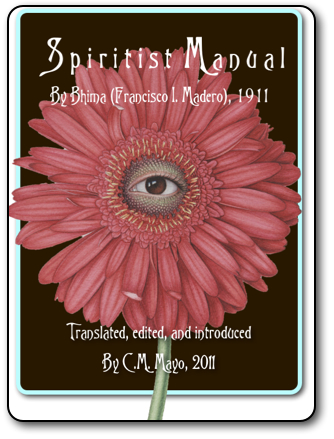
C.M. Mayo about the Translation of Francisco I. Madero's Spiritist
Manual of 1911.
 [UPDATE July 2014: This interview is about
the translation of Madero's book, Spiritist Manual, which
was originally published in late 2011. In early 2014, a revised
and expanded edition was published along with my all new book,
Metaphysical
Odyssey into the Mexican Revolution: Francisco I. Madero and
His Seceret Book, Spiritism Manual.] [UPDATE July 2014: This interview is about
the translation of Madero's book, Spiritist Manual, which
was originally published in late 2011. In early 2014, a revised
and expanded edition was published along with my all new book,
Metaphysical
Odyssey into the Mexican Revolution: Francisco I. Madero and
His Seceret Book, Spiritism Manual.]
Literal
Magazine Blog, January 30, 2012
 Rose Mary Salum: You decided to translate
Francisco I. Madero's Spiritist Manual 100 years after it first
was published. What triggered your desire to work on this project
when, even at the time the book was released, he was mocked in
newspapers as a crazy man who talked until he was blue on the
face? Rose Mary Salum: You decided to translate
Francisco I. Madero's Spiritist Manual 100 years after it first
was published. What triggered your desire to work on this project
when, even at the time the book was released, he was mocked in
newspapers as a crazy man who talked until he was blue on the
face?
C.M. Mayo: The decision was not something I thought
out-- it was intuitive, sudden, and strangely compelling. Though
I'd been living in Mexico on and off for over two decades, I
hadn't given much thought to Madero
or the Revolution; my interest in recent years has been the French
Intervention (the subject of my novel). What happened was, to
make a long story short, I had the opportunity to view Madero's
archive in Hacienda (Mexican Ministry of Finance), and when I
saw the Manual espírita, I knew it needed to be
translated. Before I could stop myself, I offered to do it. Because
of my previous
research on the French Intervention, I had a keen appreciation
for the need to translate basic works. So much history is badly
misunderstood or not even acnowledged for want of a translation!
And the fact is, Madero was the leader of Mexico's 1910 Revolution
and his Spiritist Manual, completed in that same year,
though published in early 1911, is a statement of his personal
and political philosophy. Ergo, it is a basic document for understanding
both Madero himself and the Revolution. . . . CONTINUE
READING On the Literal Magazine Blog
RMS: What is your personal
opinion on Madero´s beliefs and this book after you´ve
gotten so close to it?
CMM: I really had a rollercoaster of a ride
with this, from thinking he was naive, wise, good, nuts, way
ahead of his time, an old fuddy-duddy, heroic, daring... If you
were to ask me a year now I might say something very different
but right now, January 2012, my take on him and his beliefs is
this: I don't think he was crazy; he would not have been able
to achieve what he did as a businessman and political leader
without his druthers. As for his Spiritism, whatever one may
think of it, the fact is it was not something he invented but
adopted. (Note: it is similar to but not precisely the same as
Anglo American Spiritualism.) Though always at the far
esoteric margins of mainstream thinking, in the late 19th century
when he was studying in France and first took it seriously, Spiritism
had developed a large following and the main books by Allen Kardec
were all relatively easy to find. (Madero's own father had a
subscription to the Spiritist magazine, Revue esprít.)
Apart from reading the classics by Kardec (Book of the Spirits,
The Book on Mediums, and others), Madero also adopted ideas
from Eduoard Schuré, who claimed to have relied on a Greek
medium to channel information about Hermes, Krishna, and Jesus,
among other "divine messengers." Much better known
in France than in the US or Mexico, Schuré was a close
friend of the composer Wagner and also a friend and colleague
of Rudolph Steiner, the founder of Anthroposophy and the Waldorf
schools. In sum, Madero's Manual espírita should
be considered as a work solidly within Anglo American and European
esoteric traditions.
RMS: Allow me to pose the
same question you ask in your video: can a secret book get its
author killed? Why?
CMM:
I pose it as a question, suggesting that this may have been the
case. What we do know is that when Huerta staged the coup and
had President Madero arrested, he and U.S. Ambassador Wilson
discussed what to do with the prisoner-- put him in a lunatic
asylum? I think a good argument can be made that, like many people,
Huerta and Wilson held Spiritism in deep contempt and that very
contempt made it that much easier to kill Madero. When I say
"secret" book I mean it in the sense that Madero tried
to keep his identity as author secret by using a pen name, Bhima.
But the book itself was not meant to be secret, quite the contrary:
it had a print run of 5,000— very substantial for the time—
and its very purpose was to evangelize.
RMS: What were the consequences
of publishing this book at that time?
CMM: I
don't think there is a definitive answer because I think it is
the nature of a book— a thoughtform in a package (whether
paper or digital) that allows it to travel through time and space—
to enter into reader's mind individually and privately. Who actually
reads it? When do they read it? Where do they read it? How attentively,
and how thoughtfully? I just finished reading War and Peace.
Well, how do you know I actually read it? You just have to believe
me. And here I am in 2012 in Mexico City—
far from being the reader Tolstoy envisioned when he published
it in 1869!
But OK, I'll take a flying guess: I think the consequences of
Madero's publishing the Spiritist Manual were extremely
damaging to his political career and personal prestige because
any and all Spiritist activity was extremely disturbing to most
people in positions of authority at that time. I should underline
here that the Catholic Church considered the seance, a key ritual
in Spiritism, to be communing with the Devil and the Vatican
had banned all works by Allen Kardec, Spiritism's founder.
For any political leader in Mexico at that time, accepting, never
mind espousing Spiritism, was to venture far beyond the pale
of the acceptable. That said, Spiritism did have adherents, among
them, Ignacio Mariscal, and in France, such well-known intellectuals
as Victor Hugo and Flammarion. No doubt, somewhere in Mexico,
some people, perhaps a few hundred, read the Manual espírita
and found it both convincing and consoling. Perhaps someone else
could answer this question better than I can.
RMS: You mention in your
introduction that Madero´s book is one of the earliest
Spanish language manifestos of this new religion. What other
books on the same subject were printed in Mexico after that?
CMM:
I am more familiar with what was published before that, primarily
translations of works by Allen Kardec and other French Spiritists.
After Madero, Spiritism in Mexico, as in Brazil and the Philippines,
has taken on its individual character, mixed in with indigenous
and other traditions, over the 20th and into the 21st centuries.
Apart from Madero himself—and also in a distinctly more
rustic vein—El Niño Fidencio is considered Mexico's
best known Spiritist, though it would more accurate to say that
he was associated with Spiritism. I talk about this at length
here.
RMS: This is a question from
an editor´s point of view: Is there a market for this book
in the English speaking language?
CMM:
There is a market for anything on Madero and the Mexican Revolution
in English, albeit a slender one, and this is why I decided to
do a digital edition. I have had some interest in the book from
Spiritists, but as I have not been connected with that community
it is hard for me to gauge. I am thinking about other editions
and possibilities; I would like to see it in paper with a proper
spine.
RSM: How has your experience
been so far with your first eBook?
CMM:
After having published several books with various pubishers,
it was wicked fun to design the covers and the website without
having anyone second guess or even block my choices. On the other
hand, I have a renewed appreciation for the sometimes ginormous
amount of tedious work editors and marketing staff do for a book.
It's encouraging to see how quickly and easily one can sell a
book on amazon.com, however. I am also thrilled to see what iBooks
are turning into— much more interesting than amazon's Kindle.
RSM: Will you publish more
eBooks?
CMM:
Yes, and in fact I have two almost ready right now-- a short
story, "Manta Ray," and Marie de la Fere's My
Recollections of Maximilian, a brief eyewitness memoir
of Maximilian von Habsburg. Right
now the way I see it, each book has its own destiny: some may
be best off placed with a commercial publisher, while others
may be best self-published, and perhaps only digitally. What's
exciting is that with the very low cost of digital publishing,
so many books that would not have been feasible to publish can
now come out of their boxes and drawers and musty old archives.
As a reader, I am in heaven!
RSM: Could you advise our
readers when and where to get this and the other books you plan
to launch?
CMM:
The website for my publishing endeavors is www.dancingchiva.com
The ebooks are available on amazon.com's Kindle and will also
be available soon as iBooks on iTunes. I also post links and
information about all my works on my website, www.cmmayo.com |

 C. M. MAYO


