So you've written your
first book. Now what to do with it? It
might appear that you're about to enter the labyrinth, but no
worries, we're going to take three easy steps, and then a bird's eye view
at what is less a labyrinth than a conveyor belt. Finally, for those looking
for commercial publication, we'll look at three key areas to consider
working on immediately, if not already.
. |
THREE
EASY STEPS
. |
|
1.
IDENTIFY YOUR INTENTIONS
.
Why did you write this
book? How do you envision your book reaching its reader? (Airport bookstore? Amazon.com download?
Limited edition or print-on-demand? Multimedia iBook or Vook?
Gifted by you personally? Sold to your clients at workshops and
seminars?) What do you want this book to do for you personally
and professionally? How far are you willing to go, and how much
time and money can you spend, to make your ideal publishing experience
happen?
Many writers, agents and editors will happily give you iron-clad
prescriptions but the appropriate level of investment of your
time, money (and angst) depends on your intentions.
Some authors have no intention of doing anything more for their
book. For example, my dad completed his final draft of Captured:
The Forgotten Men of Guam, about the prisoners taken
by the Japanese in World War II, just as he was in the final
stages of terminal cancer, so  the
right thing for him was to let it go. He turned it over to his
colleague, historian Linda Goetz Holmes, and let her edit and
shepherd it to publication (it will be out in fall 2012 from
Naval Institute Press). Like many people towards the end of their
lives, having written his book, it did not make sense for him
to invest in further effort. I can think of several books in
this category— and not necessarily by people facing immanent
death (!): a perfectly healthy grandmother leaving a memoir or
children's book or family history for her family; a survivor
of a war or some long-ago event, leaving testimony; and, on a
happier note, there are also cookbooks intended for only family,
friends and maybe neighbors. the
right thing for him was to let it go. He turned it over to his
colleague, historian Linda Goetz Holmes, and let her edit and
shepherd it to publication (it will be out in fall 2012 from
Naval Institute Press). Like many people towards the end of their
lives, having written his book, it did not make sense for him
to invest in further effort. I can think of several books in
this category— and not necessarily by people facing immanent
death (!): a perfectly healthy grandmother leaving a memoir or
children's book or family history for her family; a survivor
of a war or some long-ago event, leaving testimony; and, on a
happier note, there are also cookbooks intended for only family,
friends and maybe neighbors.
Some writers, well, they just wanna have fun. Like me with the
piano: I'm OK with banging out "Chopsticks" and "Greensleeves"
once in a while. I don't have to be Vladimir Horowitz.
Some more grittily determined types want to check "write
book" off their to-do list, along with, say, "plant
a tree" and "climb the pyramids of Egypt," and
once they've typed "THE END," they're ready to slap
a cover around the pages, whatever whichway, and move on to the
next item.
A writer might be facing a deadline. How about a book written
in order to influence an local election? One wouldn't want to
publish a book about the Mayan prophecies of 2012 in 2013!
A writer who aims to publish a thriller available in airport
bookstores, however, had better be prepared to do what is necessary—possibly
months or years of work— to find an agent who can place
it with an appropriate commercial publisher. He or she had also
better be prepared to do a marathon's worth of promotional legwork.
(When you hear stories from self-publishing companies about some
self-published novel that made it to best-sellerdom, that, believe
me, is the nano-tip of the iceberg of books you have never, and
will never, ever, not even in Oz, hear about.)
Similarly, a writer who aims for a place in the literary pantheon
with Edgar Allen Poe, Edith Wharton, Ernest Hemingway, James
Joyce, Eudora Welty, and so on, had also better be prepared to
do a toe-curling amount of revision. Readers, even the most cultivated
ones, rarely guess at how many times a quality literary novel
or memoir has been revised. The reason is simple: when the writer
goes out on tour to flog their book, they have zero incentive
to confess how much work went into it, no more indeed than the
leading ballerina dancing the Sugar Plum Fairy would halt, mid-twirl,
to shout to the balcony, "AYYY, my bloody feet!!"
Some writers' goals are business
and professional success, so they don't necessarily see 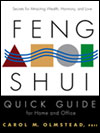 their book as an end in itself,
but as something that supports that—a calling card, as it
were, for more prestige, more clients, and, perhaps, speaking
opportunities. Some examples of this would be feng shui consultant
Carol Olmstead's Feng
Shui for Real Life and David Allen's Getting
Things Done. Dr Daniel G. Amen's popular
series of books on improving brain health come to mind, and
my own (long ago) finance
books which, verily, did wonders for my career as an economist
in Mexico. Whether self-published or commercially published,
these books, to achieve such goals, need to be exquisitely well-edited. their book as an end in itself,
but as something that supports that—a calling card, as it
were, for more prestige, more clients, and, perhaps, speaking
opportunities. Some examples of this would be feng shui consultant
Carol Olmstead's Feng
Shui for Real Life and David Allen's Getting
Things Done. Dr Daniel G. Amen's popular
series of books on improving brain health come to mind, and
my own (long ago) finance
books which, verily, did wonders for my career as an economist
in Mexico. Whether self-published or commercially published,
these books, to achieve such goals, need to be exquisitely well-edited.
Alas, many self-published writers, in taking on the job of professional
publishers without realizing the full nature and scope of the
process, make big mistakes here... more about that in a moment.
Then there are the academics aiming to share their research and,
usually, also gain stature in their field and, in particular,
tenure. They will most likely find a university press the answer
to their needs, and so their manuscript's path through the steps
we'll see below may be a little different. Mainly, they probably
won't be using an agent. (Why? Because the advances against royalties
for such books are too small to make them worth an agent's time.)
There are many other authors with niche books that may have an
audience valuable to them, but not large enough for a commercial
publisher to take interest or even if they do take interest,
they might not be able to work in the author's best interest
in a timely manner. Some examples in this category include Jim
Johnston's self-published Mexico
City: An Opinionated Guide for the Curious Traveler,
and my own translation into English of Francisco I. Madero's
Spiritist Manual of
1911. [Update
2014: my book is now published
as Metaphysical
Odyssey into the Mexican Revolution: Francisco I. Madero and
His Secret Book, Spiritist Manual.]
Many authors will find their intentions for their book in more
than one of these categories— and, no doubt, there are categories
I haven't thought to mention. It's certainly possible to change
your intentions once you change or, as often happens, you find
out how dagnabbit tough it can be to publish. Then again, for
some people it's easy to publish a best-selling book, or, say,
place their PhD thesis with Harvard University Press on their
first submission. (Some people do win the lottery, too. And as
far as I know, J.K. Rowling is a real person.)
. |
2. WHILE ACTIVELY
SEEKING OUT INFORMATION ABOUT THE PUBLISHING PROCESS, CULTIVATE
YOUR SELF-AWARENESS.
There are no formulas in
this "business";
you need to figure out what's right for you, so you need to find
your balance between humility and arrogance, overpessimism and
overoptimism, fear and naiveté. What works for one writer
and her manuscript may be wildly inappropriate for another. So
stay curious, but trust your intuition.
Guys, that means, educate yourself but in the end, go with your
gut.
One part of educating yourself is to read widely and, in your
genre, deeply. Let's say you want to publish a literary novel.
Well, then, you'd better be reading a lot of literary novels.
Compare the work that wins, say, the Pulitzer Prize, to a random
selection of self-published novels, and though I am sure 10 people
would have 10 different opinions about the novels that won over
the past decade, in general, I am confident we could find a consensus,
with perhaps one or maybe two exceptions, that the prize-winning
novels have a very different quality than the others. Look and
learn.
But again, there are no formulas. The publishing world is not
run by all-knowing gods in the sky, but human beings. Last I
checked, human beings are capable of doing and saying some really
stupid stuff. And like monkeys in funny hats, many will dance
to someone else's idea of music. So yes, it has happened that
great books go unpublished and crap gets on the bookshelves.
Godawful injustices and aesthetic barbarities plague the world
every minute. I don't know about you, but unless I am able and
willing to do something, I try not to dwell on them.
. |
|
3.
KNOW YE THAT EVERYONE, INCLUDING WIDELY-PUBLISHED WRITERS BUT
ALWAYS AND ESPECIALLY NEW WRITERS, MASSIVELY, AS IN MOUNT EVEREST
MASSIVELY, UNDERESTIMATES THE AMOUNT OF EDITING THAT NEEDS TO
BE DONE TO GET THE BOOK TO A QUALITY COMMERCIALLY PUBLISHED LEVEL.
REPEAT THAT ELEVEN TIMES.
 For more about revision, check out Anne
Lamott's Bird
by Bird: Some Instructions on Writing and Life. For more about revision, check out Anne
Lamott's Bird
by Bird: Some Instructions on Writing and Life.
Explore many more recommended books on
craft and creative process here.
 A lecture on writing memoir, by Sara
Mansfield Taber, author of several memoirs, most recently,
Born Under an Assumed Name, for the Vermont College of
Fine Art, summer 2010. A lecture on writing memoir, by Sara
Mansfield Taber, author of several memoirs, most recently,
Born Under an Assumed Name, for the Vermont College of
Fine Art, summer 2010.
.
|
WELCOME
TO
THE CONVEYOR BELT
. |
|
Now for the
conveyor belt which, depending on your intention and circumstances,
moves (maybe slowly, maybe surely) your manuscript through some
or all of these various types of readers and editors. This
is a stylized list, based on my own experience having had several
books published by diverse houses, from corporate behemoth Random
House Mondadori to university
and small presses, and my
own itsy bitsy tailor-made Dancing
Chiva.
FRIENDS
AND/OR FAMILY MEMBERS
In most cases, even if
avid readers of above-average intelligence, they wouldn't know
how to critique their way out of a paper sack. Eliciting an honest
reaction more often than not results in a lot of hurt feelings
on both sides. I no longer ask for "feedback," or "unvarnished
opinions," but rather, very specifically, for an "x"
in the margin or a circle around the text itself to indicate
where, if they didn't know me, they would have quit reading.
Usually this alerts me to a specific problem that can be directly
addressed. Manuscript improved, drama averted.
(But your loved one insists on reading it? But think: does it
make sense to show your poetic literary historical novel to someone
whose diet of reading is almost completely composed of thrillers
purchased along with the lettuce at the grocery store? Or for
that matter, a romance novel to someone who hasn't read anything
but newspapers and organic chemistry journal articles in the
past three decades?)
COLLEAGUES
AND/OR EXPERTS ON THE SUBJECT
Invaluable. But park
your ego outside. Be sure to thank them in the acknowledgements
and give them an inscribed copy of the book. (Don't hesitate
to ask for a blurb if you think you'll get one. It's never too
early to start!)
WRITING
WORKSHOP
Possibly useful. I strongly
believe in the value of writing workshops— over the years
I attended many myself, and I teach them— but the main value
is not so much in any critiques you receive, but in learning
how to critique others (and thus, eventually, your own
manuscripts). It is rare to find a workshop that will critique
book-length manuscripts, however. But not impossible. But don't
bang your head against the wall if you can't find one.
Check the Writer's
Center catalog when it comes out each season.
For those with a completed draft, in
the DC area, Richard
Peabody has led a popular novel workshop for some years.
C.M. Mayo, "Ten
Tips to Help You Get the Most Out of Your Writing Workshop"
C.M. Mayo, "Writers
Conferences: A Short List of Recommendations" (2008)
WRITERS
GROUPS
These are as varied as
wildflowers in a meadow. Like wildflowers, most are beautiful,
but some are poisonous. Ayyy, they are composed of human
beings! Start one yourself if you dare. (Don't know any other
writers? Go meet some! Join writers groups and associations,
from the Writer's Center
to the Women's National
Book Association — they accept men, by the way—
to say, the Maryland
Writers' Asociation. Take workshops. Attend seminars and
conferences.)
As with workshops, however, it
is diffcult to find a writers group that can handle critiques
of book-length manuscripts. In my experience, these are most
beneficial for working on poetry, short fiction and short essays.
Leslie Pietrzyk, "Work-in-Progress"
blog, "My
Fabulous Writing Group"
WRITING
TEACHER / PUBLISHED WRITER YOU HAPPEN TO KNOW (LIVE NEXT DOOR
TO, ETC)
Outside of the workshop,
are you offering to pay the going rate for a freelance editor?
It starts at about USD $35 an hour and goes up, way up, from
there. If not, you are asking too hefty a favor, I fear. (Would
you ask the dentist who lives next door to give your kids braces
for free?)
C.M. Mayo, "To
All the Many People Who Ask Me to Read Their Manuscripts"
[Update: someone in the seminar asked, "What
if my next door neighbor is a professional copyeditor?"
I answered, "Ask her what she charges. Since you know her,
if you don't want to pay cash, you might offer to, say, babysit
her kids for a month."]
FREELANCE
EDITOR
One of the best ways
to find a freelance editor is by recommendation from a fellow
writer. You can also find freelance editors at sites such as
the Editorial Freelancer Association
and, more broadly, www.elance.com.
 On
my webpage, at "Resources
for Writers," I maintain a frequently updated list of
recommended freelance editors. On
my webpage, at "Resources
for Writers," I maintain a frequently updated list of
recommended freelance editors.
You may also find advertisements for
editorial services in magazines such as Poets
& Writers and Writer's
Digest.
As you will find, editors vary widely in terms of experience,
typical clients (technical, literary, genre, etc), waiting lists
(or not), and the way they work. Some offer consultation, review,
developmental editing, "feedback," line editing, etc.
Some charge by the page, some by the word, others by the hour
or by the project. Some want a check, others use PayPal.
Explore their websites, which should their policies clearly and
offer a work history, samples, testimonials, and more.
Before proceeding, get a Letter of Agreement (LOA) which clearly
states what you can expect / limits to services and payment.
If you don't like their LOA, try to negotiate or find another
editor.
AGENT
If you aim to publish with a commercial publisher who distributes
to brick-and-mortar bookstores, you will probably need an agent
in order to get past the Himalaya-sized "slush piles"
(that is, unsolicited manuscripts). Some agents will refer clients
to freelance editors. Some agents will actually edit. Some agents
are wise and experienced and should be heeded; others, well,
I'm not sure they should be allowed to operate a motorized vehicle,
never mind put a red pencil to anyone's manuscript. Remember,
anyone, including your plumber, your lawyer, or your pet groomer,
can put out their shingle as a literary agent. Check their credentials
and track record before blindly accepting any editorial advice
from an agent.
My own agent, Kit Ward, was an editor at Little, Brown, a prestigious
press, for many years. She also has an impressive track record
as an agent. That said, she didn't read my novel in manuscript;
I sold it myself, then brought her in to negotiate the contract.
On a previous book, my former New York agent, who, though famous,
shall remain unnamed, made numerous editorial suggestions. Other
than obliging me to cut the clutter— which was invaluable,
and for which I remain very grateful— I found it difficult
to believe she read it with genuine care because so many of her
comments left me shaking my head in wonder, the wonder being,
which manuscript did she read? (Um, agents have a Himalaya-sized
slush piles, too.)
C.M. Mayo, Answers to the 3 Most Frequently
Asked Questions, #2, Do
I Need an Agent?
(includes many helpful links)
ACQUISITIONS
EDITOR
This editor is the one
you submit your manuscript to and he says, "no thanks,"
or, "revise and submit again," or, "yes, here's
the contract". Depending on how many hats he wears in the
publishing house, he may or may not be the one who edits your
mansucript.
PRODUCTION
EDITOR, EXECUTIVE EDITOR, MANAGING EDITOR, ETC.
In a large house these
may be different individuals, but in smaller houses they are
one and the same. Some publishers use freelancers for different
types of editing. It all depends. For example, when I published
my anthology, Mexico: A Traveler's
Literary Companion, the acquiring editor was the publisher
and owner, Dave Peattie of Whereabouts
Press, but a freelance literary translator, a very good one,
did the line editing.
Like surgery, or for that matter,
home renovation, some operations are minor and some require saws,
chisels and heavy sedation. Generally speaking— and this
is why agents often do some editing for their clients— acquiring
editors prefer to buy manuscripts that come in as close to ready-for-publication
as possible. The reason is simple: editing takes the time of
salaried (or freelance) professionals, which isn't cheap, and
the more editing that needs to be done, the greater the risk
that the author will not deliver the work in an acceptable time
frame or condition.
COPYEDITOR
When you go the route
of agent to acquiring editor to editor, nearing the end of the
conveyor belt, when (ideally) both you and your editor have made
the manuscript as as squeaky-clean as it can be, you will encounter
the eagle-eyed nitpicker known as the copyeditor.
Copyeditors catch things like,
on page 86 you use "catsup" while on page 119 you say,
"ketchup"; do you want to go with "Palacio Nacional"
or "National Palace"? Mr Wilson or Dr Wilson? (It's
Mr Wilson throghout but Dr in footnote 3 on page 49). Should
it be "carte-de-visite" or "carte
de visite"? Should the "E" in Champs-Elysee have
an accent? (Doesn't matter, but you need to be consistent.) They
often catch commas inside, when (following U.S. style), they
should be placed outside quotation marks.They make up what is
called a stylesheet, which you can refer to whenever you have
a doubt. In sum, copyediting adds value to your book by improving
its quality. It is one of the many things a publisher does to
earn their bigger cut of a book's income (leaving you the little
slice of "royalties").
When you opt to self-publish, if your aim is to produce a book
on par with commercially published works (as for example, if
you want the book to serve as your business's calling card or
to establish your expertise), you need to hire a copyeditor.
Unfortunately, few people have encountered a copyeditor or even
know what exactly what it is they do (and no, it's not copywriting),
and so when ambitious first-time authors who opt to self-publish
learn that copyediting might cost, say, $5 a page or $35 an hour
and upwards, they skip this step— to their detriment.
With the exception of the first edition of my translation of
Spiritist Manual
(because it was uploaded onto Kindle on a deadline, for my
talk at the Author's Sala in San Miguel de Allende on its centennial,
2011), all of my several books have been copyedited and in each
and every instance, after having been revised many times, and
read by many readers and editors, I have been genuinely astonished
at all the copyedits— almost every single page has something
marked. A few corrections I disagreed with, but I have always
had the chance to discuss and negotiate to my and my editor's
mutual satisfaction. That said, the overwhelming majority of
copyedits have been excellent and indeed, many have saved me
from what could have been an embarassment. And I think most writers
who have been well-published 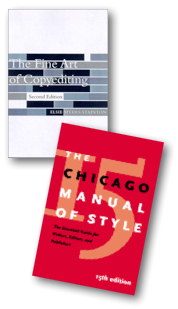 can
say the same. can
say the same.
There is so much to say about
the underappreciated yet vital profession of copyediting that,
if you're serious about publishing something of quality, I urge
you to buy a copy of this slender but superb book:
Elsie Myers Stainton, The Fine Art of Copyediting (Columbia
University Press, 2002)
Also useful to have as an editing reference:
Chicago
Manual of Style
Diana Hume George, "Copyediting.
Vital. Do it Or Have It Done"
An excellent and brief on-line article.
PROOFREADER
The proofreader catches
those spelling and punctuation mistakes which the copyeditor
missed (it happens), as well as any formatting problems and inconsistencies.
Many people use the terms copyeditor and proofreader interchangably;
I've seen the definitions of copyeditor and proofreaders overlap,
blend, contradict— oh well.
It's important to make sure you can review the work of the proofreader
before it goes to press because sometimes they make mistakes.
I had something in my collection of short stories (meticulously
edited, by the way) "corrected" by a proofreader that
was a misunderstaning on his part. It was a minor technical term
but anyone who knows about it knows my book has it wrong. Not
my fault! Grrr.
THE
CORRESPONDENTS OF THE AFTERMATH
The day will come when the box with your books arrives. And you
will take out the first, smelling-of-fresh-ink copy and you will
open it... and you will find a typo. That's right, no matter
how times and how many highly paid editors read it through from
beginning to end, red pencil-in-hand, that typo will stare you
in the face, obvious as a zit on the end of your nose and horrible
in its immortality.
This is only one of the myriad reasons I recommend checking out
all the handy tips for toughening up your mind and spirit which
sports psychologists offer in a whole library's worth of books,
the best of which, in my opinion, is Kenneth Baum's
The Mental Edge.
You will obsess about this typo— and the others.
Yes, there will be others. Some might even (gulp) appear on the
cover. How about in the title itself? I know perfectly decent,
dilgent, and intelligent people to whom this has happened.
The worst typo might appear, like a cockroach in the duxelle
of the Beef Wellington, in a sentence wherein you pretend to
assert your expertise. And you knew perfectly well what you were
talking about. Really! This has happened to me. It is
so awful that I cannot bear to continue to speak of it.
Many readers will tell you about your typos. Some may catch them
with undisguised glee! The most gleeful among them are those
who yearn to write a book (oh, they have a great idea) but they
never will precisely because they are terrified of being criticized.
Once you figure that out, it's not so bad.
A surprising number of people will write to you, listing, ever
so helpfully, page by page, all the many mistakes. Some really
are mistakes, though finding out about them, which is good if
you are to reprint your book at some point, doesn't exactly make
your day. And some are not mistakes; your correspondent doesn't
know what the barking buffalo she's talking about. I've had people
write to tell me I was wrong about the rental price of per day
for palapas on a remote beach because it had since gone up (um,
hello, it's a travel memoir?) and that a German song in
my novel does not exist (um, it's fiction?)
Nobody is perfect. Not them. Not me. Sigh. Not you, either.
When you just can't stand it anymore,
watch this.
.
|
THREE
KEY AREAS
TO CONSIDER WORKING ON IMMEDIATELY,
IF NOT ALREADY
. |
|
I.
MARKETING & PUBLICITY
In the past, marketing
and publicity were (supposedly but not really, which is another
story) the publisher's responsability. A few months after the
contract is signed, but still some months before its "pub
date," the book will be placed on another conveyor belt,
as it were, going out to reviewers, book fairs, distributors,
etc., while the publisher's sales reps and marketing staff work
hard (one hopes) to interest bookstores, libraries, reviewers,
bloggers, and press.
 Now that readers can buy books on-line,
however, search engine ranking plays a role analogous to bookshelf
space. For this reason, even if they are doing a print edition
with a commercial publisher, savvy writers often start their
websites, blogs, and social media pages with search engine optimization
in mind before the book is even written. In other words, if you're
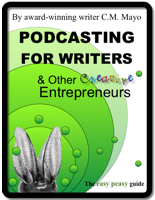
writing a book on Podcasting
for Writers, it would be ideal to have your website pop
up high on the screen when someone searches for "podcasting
for writers." Now that readers can buy books on-line,
however, search engine ranking plays a role analogous to bookshelf
space. For this reason, even if they are doing a print edition
with a commercial publisher, savvy writers often start their
websites, blogs, and social media pages with search engine optimization
in mind before the book is even written. In other words, if you're
writing a book on Podcasting
for Writers, it would be ideal to have your website pop
up high on the screen when someone searches for "podcasting
for writers."
You can see how I'm doing this for my travel memoir-in-progress,
with the Marfa Mondays Podcasting
Project 2012-2013: Exploring Marfa, Texas & Environs
in 24 Podcasts.
Savvy writers also start building their mailing lists with an
automatic opt-in / opt-out newsletter service such as Constant
Contact or Mail Chimp (learn
about my newsletter here.).
To quote marketing guru and best-selling author Seth
Godin, "The best time to start promoting your book is
three years before it comes out. Three years to build a reputation,
build a permission asset, build a blog, build a following, build
credibility and build the connections you'll need later."
See:
 Seth Godin (blog), "Advice
for Authors" Seth Godin (blog), "Advice
for Authors"
Seth Godin (video) "Sliced
Bread and Other Marketing Delights"
C.M. Mayo, blog, "Writers'
Emailed Newsletters: 6 Dos and 6 Yucky No Nos"
C.M. Mayo, blog, "Getting
Started with Websites and Blogs"
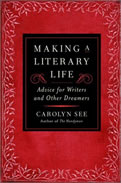
Carolyn See, Making
a Literary Life
|
.
II. PUBLISHING EXCERPTS
.
Some books, especially nonfiction works, but also collections
of poetry, short fiction, or literary essays, can benefit from
having had individual pieces in magazines prior to publication.
In fact, when evaluating such manuscripts, editors almost always
ask to see "acknowledgements," that is, a list of magazines
in which the works (or excerpts) have previously appeared. The
more and more prestigious, the better. In other words, if you
can say you've had a story in the Paris Review or Zyzzyva,
or an article in the Washington Post, that signals that
you're serious— you've made the effort to get your work
out there and some editor thought enough of it to publish it.
Your piece may also be eligible for some award— and taking
the trouble to enter appropriate contests could result in some
helpful recognition. It is almost always a simple matter to include
the work in your book, but do check your contract and always,
always, include the acknowledgement.
In my own case, two of my short stories in Sky
Over El Nido appeared elsewhere (Paris Review
and Southwest Review); several of the chapters in my travel
memoir, Miraculous Air,
appeared in magazines, among them, North American Review,
Southwest Review, and Massachusetts Review, and two
won Lowell Thomas awards. Not bad, eh?
Novels are difficult to excerpt, but I did publish the first
chapter of
The Last Prince of the Mexican Empire in Potomac Review.
It does happen.
C.M. Mayo, on-line article, "Out
of the Forest of Noise: On Publishing the Literary Short Story"
 I confess I've been much less interested
in placing shorter pieces in magazines and newspapers now that
I have a blog. For
the past few years, while working on new books, I've also become
enchanted with podcasting. I confess I've been much less interested
in placing shorter pieces in magazines and newspapers now that
I have a blog. For
the past few years, while working on new books, I've also become
enchanted with podcasting.
The downside of all this blogging and podcasting vis-a-vis publishing
in magazines and newspapers: less income, fewer readers, and
no copyediting.
The upside: I am in complete creative control of the content
as well as whether and when it gets "published." Plus,
I don't have to deal with so many editors.
Editors are a blessing, yes, but a mixed one. |
|
.
III. DESIGN AND MULTIMEDIA
.
What is a book? We are
now beginning to see inexpensively produced yet very beautiful
and rich multimedia e-books. For example, in 2012, Apple made
available the iBook Author app free to anyone with the latest
operating system. It's a breathtakingly well-designed and easy
to use software that allows you to drag and drop in video, images,
slideshows, widgets, and more. With such tools, this is a time
of tremendous creative opportunity for writers, while readers,
especially younger ones, will demand increasingly rich and complex
reading experiences.
In my opinion, the writer needs to be able to handle images,
video, audio and graphic design to a level that may not be expert—
we are, after all, writers, not cinematographers or graphic designers—
but is nonetheless congruent with the style and quality of one's
writing.
See:
Chipp Kid's TED Talk: "Designing
Books is No Laughing Matter. OK, It Is."
C.M. Mayo, www.dancingchiva.com, "My Excellent
E-Book Adventure"
iBook
Author App
Be sure to watch the video
Author Kris
Walderr's website with apps and e-books of beautiful design
Inspiring!
UPDATE: See also
It's Not Peanut Butter-and-Jelly But
It's Nor Rocket Science Either or, How I Made my POD (And You
Can, Too)
Q
& A with Michele Orwin, Founding Editor of Bacon Press Books
Ye
Olde Website Tufte-esqued or, The Chocolate-Boxy Yum of Small
Multiples |
|
|

 C. M. MAYO